

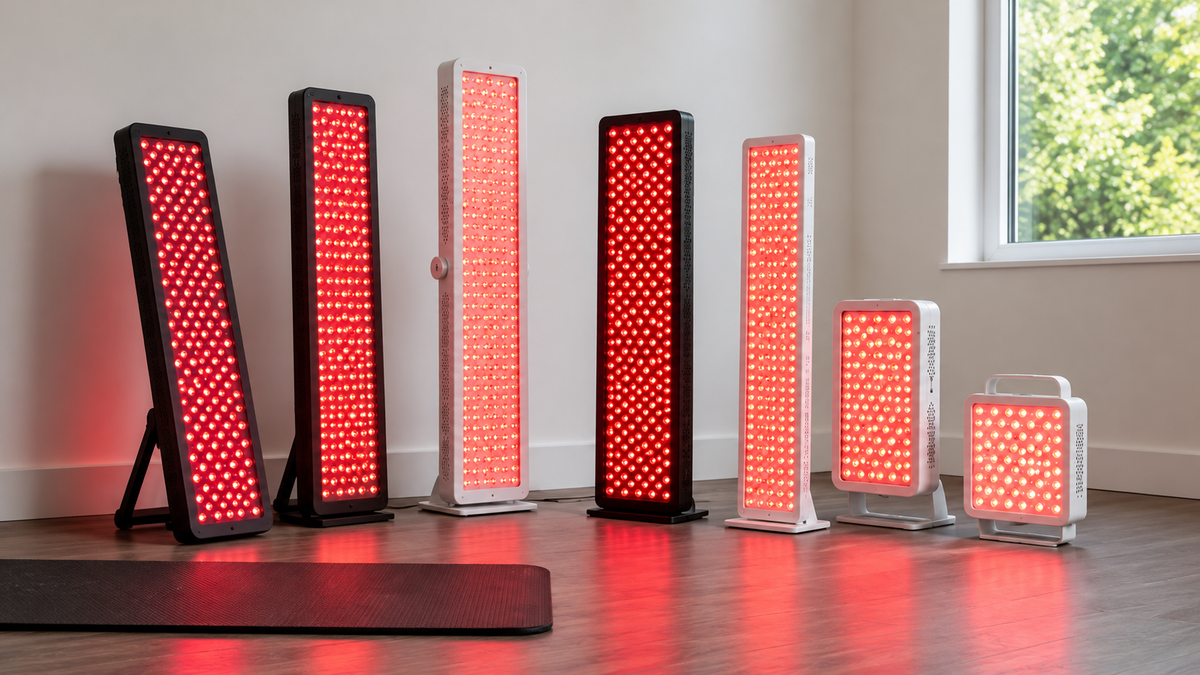
7 Best Full Body Red Light Therapy Panels for Home
Table of Contents
- Quick Comparison: 7 Full Body Red Light Therapy Panels
- How We Evaluated These Panels
- 1. The Max Panel: Tallest Full-Body Coverage
- 2. EXESAS 1216 LED: Highest Irradiance Output
- 3. The Panorama Panel: Best Adjustable Positioning
- 4. EXESAS 1008 LED: Best Balance of Power and Price
- 5. Red Light Panel 1000W: Best for Recovery and Circulation
- 6. The Large Panel: Best Mid-Range Full-Body Option
- 7. EXESAS 200 LED: Best Entry Into Full-Body Therapy
- Frequently Asked Questions
Last Updated: September 13, 2026
Quick Comparison: 7 Full Body Red Light Therapy Panels
The best full body red light therapy panels for home use in 2026 balance irradiance at a realistic standing distance, true full-body coverage, and heat management. This guide from Vital Fit Home ranks seven panels we sell on the numbers that change your results.
Red light therapy uses specific wavelengths of red and near-infrared light to stimulate mitochondrial function and cellular energy production without damaging the skin. The therapeutic window sits between roughly 630nm and 850nm.
Here is the short list before the detail.
| Panel | Price | Wavelengths | Best For |
|---|---|---|---|
| The Max Panel | $5,800 | Renew full-body spectrum | Tallest coverage, over 6 ft |
| EXESAS 1216 LED | $3,499 | 630/660/810/850nm | Highest irradiance |
| The Panorama Panel | $4,800 | Red, NIR, blue | Adjustable positioning |
| EXESAS 1008 LED | $2,799 | 630/660/810/850nm | Power and price balance |
| Red Light Panel 1000W | $2,950 | 660, 810-850nm | Recovery and circulation |
| The Large Panel | $2,250 | Renew red and NIR | Mid-range full-body |
| EXESAS 200 LED | $529 | 630/660/810/850nm | Entry-level full body |
How We Evaluated These Panels
We scored each panel on five weighted criteria: irradiance at a realistic standing distance, wavelength coverage and independent control, coverage height, heat dissipation and noise, and build quality.

Irradiance: The Only Number That Predicts Your Session
Irradiance, measured in mW/cm², tells you how much optical power reaches your skin at a given distance, and it determines session length because dose equals irradiance multiplied by time. A panel delivering 100 mW/cm² at 6 inches needs roughly half the session time of one delivering 50 mW/cm².
Almost every manufacturer quotes irradiance at zero distance, directly against the lens, where the number is highest and least meaningful. At 6 inches, output typically falls 40 to 60 percent; at 12 inches it can drop 70 percent or more. A panel advertised at 200 mW/cm² at the face may deliver 80 to 120 mW/cm² where you stand.
We weight irradiance at 6 to 12 inches, the realistic standing gap for a full-body session. Anything quoted without a distance figure is unverified.
Wavelength Coverage and Independent Control
Red light at 630nm and 660nm is absorbed in the epidermis and upper dermis, supporting collagen production and surface skin appearance (PubMed). Near-infrared at 810nm and 850nm penetrates deeper into muscle and joint tissue (PubMed). Panels with both bands and independent controls let you run red-only, NIR-only, or combined sessions.
We also check for dual-chip LEDs (two diodes in one housing) versus single-chip, since dual-chip designs produce higher output per square inch.
Coverage Height
A true full-body panel should cover from roughly the top of the head to mid-thigh in one standing pass for an average-height adult. We measure illuminated height, not frame dimensions, since bezels and mounting hardware reduce usable coverage. Panels under about 60 inches of illuminated height require repositioning for taller users.
Heat Dissipation and Noise
LED panels convert a meaningful share of input power into heat, which shortens LED lifespan if unmanaged. We look at active cooling (fans) versus passive cooling (aluminum heat sinks), fan count, and audible noise at standing distance. A fan above roughly 45 decibels is noticeable in a quiet room; below 35 decibels it fades into background noise.
Build Quality: Drivers, Fans, and Warranty
The LED driver is the component most likely to fail first in a cheap panel. Branded drivers hold output stable over years, while unbranded drivers can drift or fail within 12 to 24 months. We note the driver brand where disclosed, rated LED lifespan (most quality panels rate 50,000 to 100,000 hours), fan type, and warranty length. A two-year warranty on a panel rated for a decade of daily use signals confidence; a 90-day warranty does not.
Safety and EMF
Red and near-infrared panels in this class are Class II or Class III consumer devices and are not subject to the FDA's premarket approval pathway for medical devices when marketed for general wellness (the FDA). That means you must check the basics: flicker-free operation (flicker can trigger headaches and eye strain), eye protection guidance, and EMF emissions. Quality panels publish EMF readings at standing distance; a common target is under 2 milligauss at 6 inches.
What We Did Not Weight
We did not weight app connectivity, Bluetooth pairing, or preset "programs" heavily. These features are convenient but do not change the light your skin receives. A panel with a basic timer and a physical dial can outperform a feature-heavy panel with weaker irradiance.
1. The Max Panel: Tallest Full-Body Coverage
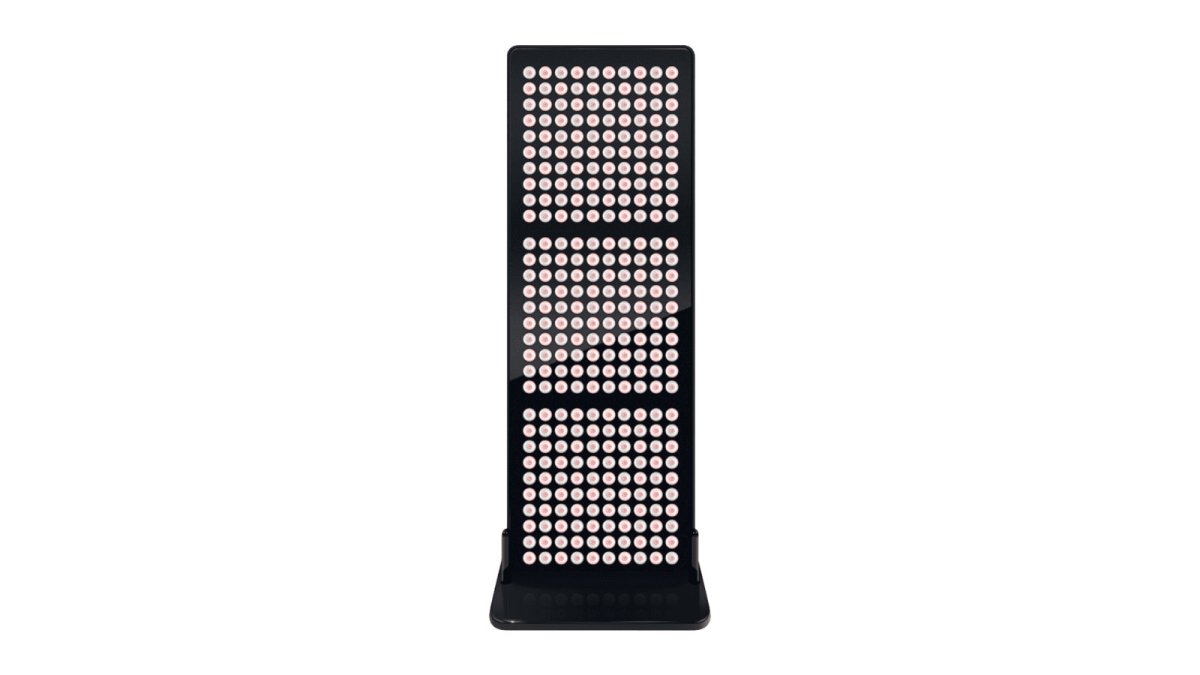
The Max Panel is the tallest option here, standing over 6 feet, and the only panel that covers a full adult frame in one standing session without repositioning. If you are over 5'10" and want head-to-toe exposure, this is the one.
Renew engineered it with high-output LEDs and preset modes, so you are not dialing in settings every session. The clinically studied wavelengths target inflammation reduction, recovery, and skin health in a single pass.
The catch is price and footprint. At $5,800 it is the most expensive panel here, and you need a dedicated wall roughly the height of a doorway. For a purpose-built wellness room, that is a reasonable trade. For a shared bedroom, measure twice.
2. EXESAS 1216 LED: Highest Irradiance Output
Raw output is where the EXESAS 1216 LED wins. With 1216 dual-chip high-output LEDs and irradiance above 220 mW/cm², it delivers the strongest light in this lineup, meaning shorter sessions for the same dosage.

Dual-chip LEDs put two diodes in a single housing, producing more efficient output than single-chip panels. You get four wavelengths (630nm, 660nm, 810nm, 850nm), independent red and infrared controls, flicker-free performance, and a low-EMF design. The 75" x 22" frame covers a full body, and the included base stand, remote, timer, and cooling fans make daily use simple.
Where it falls short: the cooling fans are audible, and at $3,499 it sits in premium territory. The 100,000-hour LED lifespan and 2-year warranty soften that.
3. The Panorama Panel: Best Adjustable Positioning
Most panels lock you into standing. The Panorama Panel's adjustable stand positions vertically, horizontally, or anywhere in between, so you can run a session lying down, seated, or standing.
That flexibility matters if you have limited standing tolerance or want to treat a specific area, like a shoulder or lower back, at close range while still getting expansive coverage. It combines red, near-infrared, and blue light in a high-output design, broadening its use beyond recovery into skin health.
At $4,800, you are paying for the articulation and the three-light spectrum. The drawback is that a fully adjustable stand adds a moving part a fixed wall panel does not have. If you never plan to change position, a fixed panel gives you the same light for less.
4. EXESAS 1008 LED: Best Balance of Power and Price
The EXESAS 1008 LED is the sweet spot for most buyers: 1008 dual-chip medical-grade LEDs, four wavelengths (630nm, 660nm, 810nm, 850nm), and irradiance above 198 mW/cm² for $2,799.

What most reviews miss is the driver quality. This panel uses Meanwell LED drivers, the same class of component found in professional medical equipment, rather than the unbranded drivers common at this price, stable output over years, not months. You also get separate or combined red and NIR modes, an integrated timer, LCD control panel, remote, and built-in cooling fans.
The 73" x 21" frame is slightly shorter than the 1216, so very tall users should check coverage height. For everyone else, this is the panel we would hand a first-time buyer without hesitation.
5. Red Light Panel 1000W: Best for Recovery and Circulation
If your goal is post-training recovery rather than skin, the Red Light Panel 1000W is built for it. It delivers red at 660nm and near-infrared at 810-850nm, targeting cellular energy production and recovery after physical stress.
Regular use supports muscle performance, joint comfort, and circulation, which is why athletes gravitate to this configuration. The 660nm band handles surface circulation and skin appearance, while 810-850nm reaches deeper tissue where soreness lives.
At $2,950, it undercuts the 1008 while covering the recovery wavelengths most people need. The tradeoff is a narrower wavelength spread than the four-wavelength EXESAS panels. If skin rejuvenation is your priority alongside recovery, step up to a four-wavelength model.
6. The Large Panel: Best Mid-Range Full-Body Option
The Large Panel brings professional-grade performance home at $2,250, the lowest price among the full-height options here, with wide coverage, consistent output, and preset modes that remove the guesswork from session setup.
For a home wellness room, the value proposition is straightforward: full-body coverage and customizable settings at a price that leaves budget for the rest of your recovery setup. It fits a spare room without dominating it.
The limitation is that it does not publish the same headline irradiance figures as the EXESAS 1216 or 1008. If you want the strongest output per minute, look up the list. If you want dependable full-body sessions and a lower entry point, this is the sensible pick.
7. EXESAS 200 LED: Best Entry Into Full-Body Therapy
The EXESAS 200 LED is the lowest-cost way into full-body red light therapy in this lineup at $529, and it does not gut the core specs to get there: 200 dual-chip medical-grade LEDs, four wavelengths (630nm, 660nm, 810nm, 850nm), and irradiance above 224 mW/cm² at the panel face, with red and infrared modes that run separately or together.
What "Entry-Level Full Body" Actually Means
The 36" x 8.5" illuminated face is the honest compromise: this is a targeted panel, not a full-height one. A full-body session means covering the body in zones, roughly three to four minutes on the front torso, the same on the back, and shorter passes on the legs and arms. Total session time lands in the 15 to 25 minute range, versus a single 10 to 15 minute standing pass with a full-height panel.
That is a real difference. If your goal is a quick daily habit you will actually keep, a small panel that takes 20 minutes beats a $3,000 panel you use twice a month. If your goal is maximum dose per minute across the whole body, save for a full-height model.
The Two-Panel Upgrade Path
Two EXESAS 200 units can be linked to cover a larger area, the smartest way to grow into full-body coverage. Side by side they give roughly 72 inches of combined width, covering a full adult frame in a single standing pass at a fraction of the cost of a dedicated full-height panel. Start with one, add the second when the habit sticks.
What Comes in the Box
The included stand, remote, timer, and door mount mean you can start sessions the day it arrives without buying a mounting system. The door mount is underrated for renters, no wall drilling, no permanent installation, and it stores flat against a closet wall.
Long-Term Ownership: What Nobody Tells You
This is the part most buying guides skip, and it matters more on an entry-level panel.
LED failure. Individual LEDs can fail or dim over time, and on a 200-LED panel a single dead diode is a small percentage of total output, usually not worth a repair. Watch for clusters of dead LEDs, which suggest a driver problem rather than individual diode failure. If a cluster goes dark, contact the manufacturer before the warranty expires; driver replacement is straightforward on most panels in this class.
Fan maintenance. Panels with active cooling draw dust into the housing, and dust on the heat sink reduces cooling efficiency, shortening LED life. Every three to six months, power the panel off, unplug it, and blow compressed air through the fan intake and exhaust vents. Hold the fan blades still with a soft brush so you do not overspin the bearing. This five-minute task is the highest-value maintenance step you can take.
Output drift. LED output declines gradually over thousands of hours, and a panel rated at 50,000 hours will lose a meaningful fraction of its original output well before that point. If sessions feel less effective after two or three years, check output with a solar power meter at your usual standing distance and compare it to your original reading. If output has dropped more than about 30 percent, replace the panel or add a second one.
Storage and environment. Keep the panel out of humid rooms like bathrooms and away from direct sun through windows, both of which accelerate component degradation. A climate-controlled spare room or home gym is ideal.
Who This Is For
Buy the EXESAS 200 if you are new to red light therapy, want to test whether it fits your routine before committing to a full-height panel, or need a portable option you can move between rooms. Skip it if you are over 5'10" and want head-to-toe coverage in one standing pass, or if you already know you will use the panel daily and want to avoid the upgrade step.
Frequently Asked Questions
What is the best red light therapy panel for full body treatment at home?
The best panel depends on your space and budget. The Max Panel ($5,800) offers the tallest full-body coverage at over 6 feet, while the EXESAS 1216 LED ($3,499) delivers the highest irradiance at over 220 mW/cm². For a mid-range option, The Large Panel ($2,250) balances coverage and price. Focus on irradiance, wavelength range (630-850nm), and treatment area rather than brand name alone.
How do I choose the right size red light therapy panel for my needs?
Measure your available wall or floor space and your height. Panels like The Max Panel (over 6 feet tall) suit standing full-body sessions, while The Large Panel or EXESAS 1008 cover most of the body in one position. If you plan to treat specific areas like knees or shoulders, a smaller panel such as the Red Nova Light Solo 300 ($199) works. Full-body coverage generally requires a panel at least 60 inches tall.
Are full body red light therapy panels worth the investment?
If you use them consistently, they can replace multiple clinic visits. A $2,250 panel used three times per week costs less over two years than repeated in-office sessions. Panels with 100,000-hour LED lifespans, like the EXESAS 1216 and Red Nova Solo 300, last years with minimal upkeep. The key is matching the panel's irradiance and wavelength range to your recovery, skin, or sleep goals.
How often should you use a full body red light therapy panel?
Most home protocols suggest 10-20 minutes per session, three to five times per week. Start with 5 minutes at a comfortable distance (12-18 inches) and increase gradually. Red light therapy dosage guidelines often cite 10-50 joules per centimeter squared per session. Panels with built-in timers, like the EXESAS models, help you stay consistent without overdoing exposure.
Are there safety standards for home-use red light therapy devices?
Look for panels with low EMF design, flicker-free output, and third-party testing. The EXESAS 1216 and 1008 both feature low EMF and flicker-free performance. The Red Nova Solo 300 rates 0 EMF at 3 inches. Always use protective eyewear and consult a healthcare provider if you are pregnant, have a medical condition, or take photosensitizing medications.


Leave a comment
This site is protected by hCaptcha and the hCaptcha Privacy Policy and Terms of Service apply.