
Is At-Home Red Light Therapy Worth the Investment?
Table of Contents
- How At-Home Red Light Therapy Works and Why Wavelength Matters
- Clinical Evidence: What Studies Show About Red Light Therapy
- Best Red Light Therapy Device Features to Look For
- How Long to Use Red Light Therapy for Visible Results
- Red Light Therapy Side Effects and Safety Profile
- Cost Comparison: In-Office Treatments vs. Home Devices
- Who Should Skip Red Light Therapy: Contraindications and Skin Types
- Frequently Asked Questions
Last Updated: September 12, 2026
How At-Home Red Light Therapy Works and Why Wavelength Matters
At-home red light therapy works by delivering specific wavelengths of red and near-infrared light through the skin to reach the mitochondria, the energy-producing structures inside your cells. This process, called photobiomodulation, is the same mechanism behind the professional treatments offered in dermatology clinics. The difference is power, not principle.
The wavelength determines what the light actually does. Red light at 630 to 660 nanometers is absorbed by the epidermis and upper dermal layer, where it supports collagen production and skin texture. Near-infrared light at 810 to 850 nanometers penetrates deeper into muscle and joint tissue, which is why recovery-focused devices pair both wavelengths. A panel that only emits one wavelength is solving half the problem.
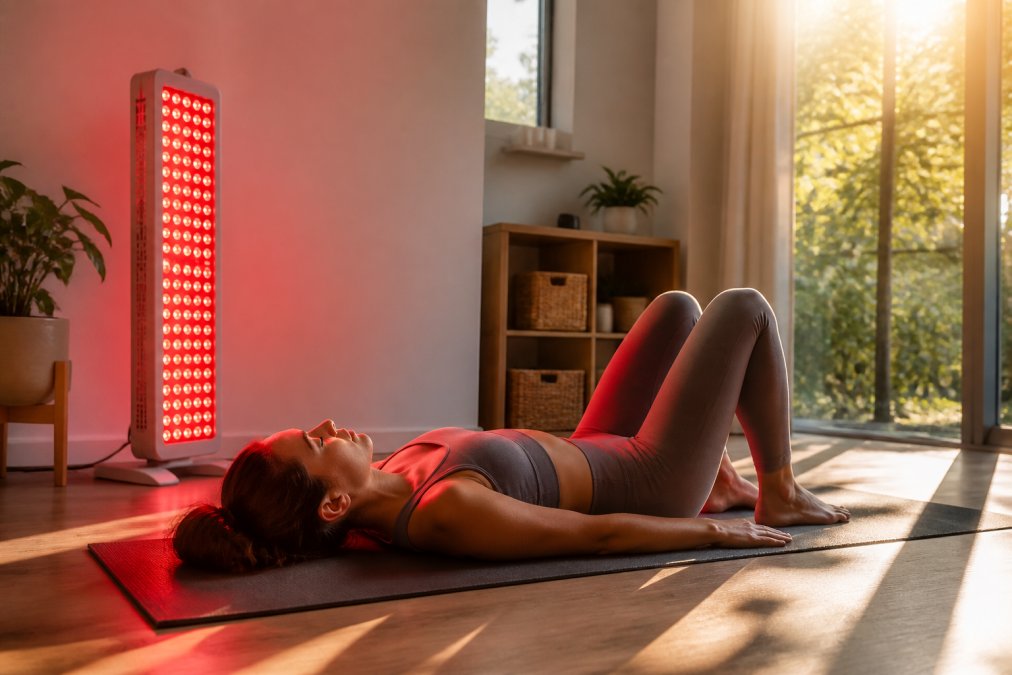
A woman in athletic wear lying on a mat in a bright home wellness room, a large red light panel glowing softly behind her while late afternoon sun comes through a window
Photobiomodulation and Cellular Energy in Plain Terms
Photobiomodulation is the process by which red and near-infrared light stimulate mitochondria to produce more ATP, the molecule your cells use for energy. More available energy means faster tissue repair, reduced inflammation, and improved skin cell turnover.
You do not need a biology degree to evaluate a device. You need three numbers: wavelength, irradiance, and fluence. Wavelength decides depth. Irradiance, measured in milliwatts per square centimeter, decides how quickly energy is delivered. Fluence, measured in joules per square centimeter, is the total dose per session. Get those right and the rest is convenience.
Clinical Evidence: What Studies Show About Red Light Therapy
The clinical evidence for red light therapy is not evenly distributed. Some conditions have decades of peer-reviewed support; others have promising early data and a lot of marketing on top of it. Knowing which is which is the difference between a smart purchase and an expensive experiment.
Here is how the evidence stacks up by use case:
- Skin rejuvenation and fine lines: The strongest body of evidence. Multiple randomized controlled trials and meta-analyses show measurable improvements in skin texture, elasticity, and wrinkle depth with consistent red light exposure in the 630 to 660 nanometer range over 8 to 12 weeks.
- Acne and inflammatory skin conditions: Moderate evidence. Several controlled studies show reduced lesion counts with blue and red light combinations, though results vary by severity and skin type.
- Musculoskeletal pain and recovery: Moderate to strong evidence for joint pain, muscle soreness, and tendinopathy, particularly with near-infrared wavelengths in the 810 to 850 nanometer range. This is the area where professional sports teams and physical therapy clinics have adopted the technology most aggressively.
- Hair regrowth: Emerging evidence. A handful of controlled trials show modest improvement in androgenetic alopecia, but the effect size is smaller than what device marketing typically implies.
- Wound healing and post-surgical recovery: Moderate evidence, mostly from clinical settings rather than home use.
- Weight loss and fat reduction: Weak evidence. This is where the gap between marketing claims and published data is widest.
The PubMed database of photobiomodulation research indexes this body of work, and the pattern across it is consistent: therapeutic effect depends on correct dosage, not on how impressive the device looks.
Why Clinical Trials and Home-Use Studies Tell Different Stories
This is the part most guides skip. Clinical trials use calibrated, high-irradiance equipment under controlled conditions with measured dosimetry. Participants are often treated by a technician who verifies distance, session length, and skin response.
Home-use studies are messier. Devices vary enormously in real-world output, users guess at distance, and self-reported compliance is unreliable. A device that underdelivers on irradiance will underdeliver on results no matter how faithfully you use it.
That gap is the single biggest reason people conclude red light therapy "didn't work" for them. It usually wasn't the therapy. It was the hardware, the dose, or the consistency.
How to Read a Red Light Therapy Study Before You Buy
When a product page cites "clinical studies," check three things:
- Was the study on the same wavelength the device emits? A 660 nanometer skin study does not validate an 850 nanometer recovery panel.
- Was the dose comparable? Look for irradiance and session length. If the study used 100 mW/cm² for 10 minutes and the device delivers 20 mW/cm² at treatment distance, the results do not transfer.
- Was it a controlled trial or a case series? Case series and manufacturer-funded studies are weaker evidence than independent randomized controlled trials.
If a brand cannot answer those three questions, treat the claim as marketing, not evidence.
Best Red Light Therapy Device Features to Look For
The best red light therapy device features to prioritize are verified wavelength output, sufficient irradiance at a realistic treatment distance, and coverage wide enough to treat the target area in one session. Everything else is secondary.
Check these in order:
- Wavelength specificity: 630nm, 660nm, 810nm, and 850nm are the clinically studied ranges. Vague claims like "red spectrum" are a red flag.
- Irradiance at distance: Ask for the measurement at 15 to 30 centimeters, not directly against the panel. Output drops sharply with distance.
- Coverage area: A full-body mat or blanket treats more surface in less time than a small panel.
- Dual-chip LEDs: These allow multiple wavelengths from a single diode, which improves consistency across the treatment area.
- Preset modes: Useful for treatment consistency, especially if you are rotating between skin and recovery protocols.
Irradiance, Fluence, and Treatment Coverage
Irradiance tells you how fast the dose arrives. Fluence tells you the total dose. Coverage tells you how much of your body receives it in a single session.
A high-irradiance device with narrow coverage forces you to reposition repeatedly, which is where treatment consistency breaks down. For full-body use, coverage matters more than peak output. Vital Fit Home stocks full-body systems including the EXESAS 1216 LED Full Body Red Light Therapy Panel, which pairs 1,216 dual-chip LEDs across four wavelengths with even irradiance across the panel.
Device Type |
Typical Coverage |
Best For |
Session Setup |
|---|---|---|---|
Small panel |
One targeted area |
Face, single joint |
Repositioning required |
Torso and limbs |
Skin and localized recovery |
One or two positions |
|
Full-body mat |
Entire body |
Recovery and skin together |
Lie down, no setup |
Full-body blanket |
Entire body, wrapped |
Convenience and portability |
Lie down, wrap |
How Long to Use Red Light Therapy for Visible Results
Most home protocols call for 10 to 20 minutes per session, three to five times per week, with the first changes in skin texture appearing after four to six weeks of consistent use (the American Academy of Dermatology). Recovery-focused users often report earlier effects on soreness, sometimes within the first two weeks.

The Large Panel – Full Body Red & Near-Infrared Light Therapy Panel
The variable that decides your outcome is not session length. It is treatment consistency. A 10-minute session five days a week beats a 30-minute session twice a week, every time. Your cells respond to repeated, moderate stimulation, not occasional large doses.
Start at the lower end of the range and increase gradually. Overdoing it does not accelerate results, and it can leave skin feeling warm or sensitive.
Red Light Therapy Side Effects and Safety Profile
Red light therapy side effects are rare and typically mild: temporary skin redness, warmth, or slight sensitivity at the treatment site. These usually resolve within hours. The safety profile is favorable enough that the technology is used in dermatology and physical therapy settings, but "low risk" is not the same as "no contraindications."
What most guides miss is that the eyes deserve attention. Bright panels emit intense light, and staring into them is not part of any protocol. Protective eyewear is standard practice during face and full-body sessions.
If you take photosensitizing medication, including certain antibiotics and acne treatments, ask your physician before starting. The same applies if you have a history of skin cancer or are pregnant. These are questions for a clinician, not a product page.
Cost Comparison: In-Office Treatments vs. Home Devices
In-office red light therapy sessions typically run $50 to $150 per visit depending on the market and the provider, and results depend on frequency. A typical protocol calls for two to three sessions per week for 8 to 12 weeks, then maintenance sessions after that. Run the math on a moderate plan, two sessions a week at $75 each for three months, and you are already at roughly $1,800 before maintenance. A home device is a one-time purchase that you use indefinitely, which changes the math entirely once you commit to a multi-month protocol.
Run the comparison honestly:
- In-office: low upfront cost, ongoing per-session fees, travel time, scheduling constraints, and results that fade if you stop booking.
- Home device: higher upfront cost, no per-session fees, zero travel, unlimited sessions, and results that hold as long as you keep using it.
If you plan to treat consistently for a year or more, the home device usually wins on total cost. The break-even point for most mid-range home devices falls somewhere between 15 and 30 in-office sessions, which is roughly two to four months of a typical clinical protocol. If you want to test whether the therapy suits you before committing, a few in-office sessions first is a reasonable path.
For full-body coverage at home, the EnergyLounger Blanket uses 660nm red and 850nm near-infrared light in a wrap design, and the Nushape LipoMat delivers 635nm and 850nm across 1,600 medical-grade LEDs in a lie-down format. Both replace dozens of per-visit sessions with one purchase.


Long-Term Maintenance and Compliance Considerations
Home devices have almost no ongoing maintenance cost. There are no consumables, no replacement bulbs on a schedule, and no service contracts. LED diodes in quality panels are rated for tens of thousands of hours of use, at 20 minutes a day, that is years of sessions before output degrades noticeably. Energy consumption is negligible; a full-body panel draws roughly what a small space heater draws, and only while it is on.
The real long-term cost is behavioral: will you actually use it?
This is where most buyers fail. The device gets installed, used enthusiastically for three weeks, and then sits idle. A common pattern reported by home users is a sharp drop-off after the first month, once the novelty fades and the routine has not yet become automatic. Before you buy, decide where it lives. A device stored in a closet gets used a fraction as often as one set up in a dedicated space you walk past daily.
Vital Fit Home's wellness design services help customers determine which technologies and products best fit their space, goals, and lifestyle. Customers planning a recovery room or home spa can map out where a panel, mat, or blanket fits alongside other equipment before committing to a layout. For a single device, the Large Panel is the straightforward starting point at $2,250, with preset modes that remove guesswork from daily sessions.
Who Should Skip Red Light Therapy: Contraindications and Skin Types
Red light therapy is not appropriate for everyone, and the contraindications matter more than most product pages admit. Skip it, or get medical clearance first, if any of the following apply to you.
- Photosensitizing medications: Certain antibiotics, retinoids, and diuretics increase light sensitivity.
- Active skin cancer or a history of it: Light exposure in affected areas requires physician guidance.
- Pregnancy: Insufficient safety data for routine use; consult your doctor.
- Very fair or highly reactive skin: Start with shorter sessions and lower irradiance.
- Recent cosmetic procedures: Wait until the skin barrier has fully recovered.
For deeper skin tones, the concern is different. Red light therapy does not target melanin the way lasers do, so the risk profile is generally favorable, but dosing should still start conservatively. As the American Academy of Dermatology notes, any light-based treatment is best discussed with a dermatologist when you have an underlying skin condition.
The challenge with at-home red light therapy is not deciding whether the science holds up. It is choosing hardware that delivers a real therapeutic dose and building a routine you will actually keep. Vital Fit Home helps with both, offering full-body systems with verified wavelengths, a free room visualizer to plan where your equipment lives, and wellness design guidance to match devices to your goals. Get started with Vital Fit Home and build a recovery space you use every day.
Frequently Asked Questions
What is the downside of red light therapy?
Most downsides are minor: temporary skin redness, mild warmth, or irritation in sensitive areas. Serious side effects are rare when devices are used as directed. The bigger practical downside is inconsistency. Results depend on regular sessions, and skipping weeks can erase progress. Some users also find the upfront cost of a home device hard to justify if they do not stick with a routine. If you have photosensitivity or take medications that increase light sensitivity, check with a dermatologist first.
How often should you use red light therapy to see results?
Most home-use protocols recommend 10 to 20 minute sessions, three to five times per week. Visible changes in skin texture or fine lines often take 8 to 12 weeks of consistent use. For recovery or pain goals, some users report benefits sooner, within 2 to 4 weeks. The key is consistency over intensity. A device with preset modes and timers makes it easier to follow a treatment protocol without overthinking dosage or session length.
What is the difference between clinical-grade and consumer-grade red light devices?
Clinical-grade devices typically deliver higher irradiance and more precise wavelengths, which means shorter sessions and deeper tissue penetration. Consumer-grade devices vary widely. Some at-home panels and mats now reach therapeutic levels of irradiance at specific wavelengths like 660nm and 850nm, closing much of the gap. The trade-off is usually coverage area and session time. A full-body mat or large panel can deliver meaningful light exposure at home, though it may take longer than an in-office session.
Is red light therapy scientifically proven or just a wellness trend?
Red light therapy, also called photobiomodulation, has been studied for decades. Clinical trials support its use for wound healing, pain reduction, and skin rejuvenation, though results vary by condition and device quality. The FDA has cleared certain devices for specific indications, which means they meet safety and efficacy standards for those uses. It is not a cure-all, and marketing often outpaces the evidence. The strongest case is for targeted skin and recovery goals with a device that delivers the right wavelength and dosage.



Leave a comment
This site is protected by hCaptcha and the hCaptcha Privacy Policy and Terms of Service apply.