


How to Maintain Water Hygiene in Cold Plunges: 2026 Guide
Table of Contents
- Why Water Hygiene Matters in Cold Plunge Tubs
- Cold Plunge Water Filtration Systems: Cartridge, UV, and Ozone
- Best Sanitizer for Cold Plunge: Chlorine, Bromine, or Hydrogen Peroxide?
- How Often to Change Cold Plunge Water (and When to Shock)
- Step-by-Step: Testing pH, Alkalinity, and Water Clarity
- Preventing Algae, Biofilm, and Scale Buildup
- Hard Water vs. Soft Water and Seasonal Cold Plunge Care
- Conclusion: Building a Simple Weekly Hygiene Routine
- Frequently Asked Questions
Last Updated: September 14, 2026
Why Water Hygiene Matters in Cold Plunge Tubs
Knowing how to maintain water hygiene in cold plunges means controlling microbial growth, chemical balance, and organic contamination so the water stays safe for repeated skin contact. At Vital Fit Home, we tell every customer the same thing: a cold plunge is a small, warm-bodied body of water. Each plunge sheds skin cells, sweat, oils, and trace amounts of urine into a few hundred gallons. Without circulation and sanitation, that load feeds bacteria, biofilm, and algae within days.

The consequences are not cosmetic. Poorly maintained plunge water is linked to skin irritation, ear and sinus infections, and respiratory irritation from aerosolized pathogens, a concern the CDC guidance on healthy swimming and recreational water illness addresses directly. The fix is not complicated, but it is chemistry-dependent, and most owners underestimate how fast a small volume of water degrades.
Below, we break down filtration, sanitizer choice, testing, and a realistic weekly routine.
Cold Plunge Water Filtration Systems: Cartridge, UV, and Ozone
Cold plunge water filtration systems combine three mechanisms: physical capture, UV sterilization, and ozone oxidation. Understanding which does what prevents the most common mistake we see: assuming a filter alone keeps water clean.

Cartridge filtration traps particulates down to a rated micron level, typically 20 microns. Cartridges remove sediment, hair, and some microbial load, but nothing for dissolved contaminants or organisms that pass through the mesh.
UV sterilization uses a lamp inside the circulation loop to neutralize bacteria, viruses, and some protozoa as water passes the bulb. It only treats water that passes the lamp, so turnover rate determines effectiveness.
Ozone generators inject ozone gas into the water, oxidizing organic matter and destroying pathogens on contact. Ozone is powerful but requires contact time and proper venting.
A submersible pump drives the whole system. Without circulation, filtration and UV treatment are effectively decorative, so most quality setups run the pump on a schedule that achieves adequate turnover.
For owners who want the three mechanisms working together out of the box, the RevX X-FLOW Cold Plunge Filtration System pairs a 20-micron cleaning pump with UV sterilization and continuous circulation, the simplest way to guarantee all three functions are running.
Best Sanitizer for Cold Plunge: Chlorine, Bromine, or Hydrogen Peroxide?
The best sanitizer for a cold plunge depends on your water temperature, your sensitivity to disinfection byproducts, and how much maintenance you will tolerate. No single option wins everywhere, but the differences matter more in a 60- to 100-gallon tub than in a 20,000-gallon pool, because there is almost no dilution buffer to absorb a dosing mistake.

| Sanitizer | Effective Range | Strengths | Watch-Outs |
|---|---|---|---|
| Chlorine (unstabilized) | 1-3 ppm free chlorine | Fast kill, cheap, easy to test | Odor, skin and eye irritation, byproducts |
| Chlorine (stabilized) | 1-3 ppm free chlorine | Slower burn-off in sun | Cyanuric acid accumulates and locks chlorine |
| Bromine | 3-5 ppm | More stable at higher temps, gentler odor | Slower kill rate, harder to find |
| Hydrogen peroxide | 30-100 ppm | No odor, no chloramines, gentle on skin | Needs frequent dosing, weaker residual |
Chlorine remains the most common choice because it is inexpensive, widely available, and kills pathogens quickly. The trade-off: chlorine reacts with sweat, urine, and skin cells to form chloramines, the compounds behind the "pool smell" and irritation in sensitive users. In a cold plunge, chloramine buildup happens fast because the bather-to-water ratio is extreme, one person in 80 gallons is roughly equivalent to 25 people in a 2,000-gallon swim spa. That is why a tub can smell strongly of chlorine even when free chlorine reads normal: combined chlorine (chloramines) has climbed.
If you use stabilized chlorine (containing cyanuric acid), note that cyanuric acid does not evaporate or get consumed, it only leaves when you drain. As it accumulates, it binds free chlorine and renders a growing fraction ineffective, so you dose more and more to hold the same residual. Once cyanuric acid climbs past roughly 30-50 ppm in a small tub, a drain and refill is cheaper than fighting it.
Bromine performs better in warmer water and holds a more stable residual, which matters if your chiller runs less aggressively or the tub sits in a warm room. It is gentler on skin with less odor, but kills more slowly and is harder to source locally. Bromine forms bromamines, which, unlike chloramines, retain some sanitizing power, so the "spa smell" is less pronounced.
Hydrogen peroxide suits owners who want no chlorine smell and no disinfection byproducts. It breaks down into water and oxygen, making it attractive for skin-sensitive users and anyone managing eczema or psoriasis who reacts to chlorinated water. The catch: peroxide has no meaningful residual, so it must be dosed more often and monitored closely, often daily in a heavily used tub. It also kills pathogens more slowly than chlorine, so it works best paired with UV or ozone.
Whichever you choose, never mix sanitizers. Combining chlorine and peroxide neutralizes both and can create a false sense of safety. Pick one, dose it consistently, and test it.
For a fully integrated setup, the Blizzard Cold Plunge Package and Whiteout Cold Plunge Package both include filtration and ozone sanitation built in, reducing manual sanitizing.
How Often to Change Cold Plunge Water (and When to Shock)
Most home cold plunges need a full water replacement every two to four weeks with regular sanitizing, or weekly if usage is heavy and sanitizer demand keeps climbing. That range reflects how quickly total dissolved solids, cyanuric acid (if you use stabilized chlorine), and organic load accumulate in a small volume.
Shock treatment, or oxidation, differs from routine sanitizing. Routine sanitizing maintains a residual that kills pathogens; shocking raises the oxidizer level high enough to burn off accumulated chloramines, body oils, and organic waste in one pass. Shock when:
- The water smells strongly of chlorine despite normal readings
- The water looks cloudy or dull
- Multiple people have used the tub in a short window
- Free chlorine will not hold a reading after dosing
A common mistake is treating shock as a substitute for draining. Shocking resets water chemistry; it does not remove dissolved solids. Once total dissolved solids climb past the point where sanitizer demand outpaces your dosing, draining is the only fix.
Step-by-Step: Testing pH, Alkalinity, and Water Clarity
Testing takes about five minutes and prevents nearly every water quality problem we hear about.
- Collect a water sample from elbow depth, away from the return jet, in a clean cup.
- Test pH first. Target 7.2 to 7.8 (the CDC). Below 7.2, water becomes corrosive and irritates skin; above 7.8, sanitizer loses effectiveness.
- Test total alkalinity. Target 80 to 120 ppm (the CDC). Alkalinity buffers pH, so if it is low, pH will swing wildly no matter how often you adjust it.
- Test sanitizer level. Match your reading to the range for your chosen sanitizer.
- Check clarity and smell. Cloudy water or a strong odor means shock or drain, regardless of readings.
- Adjust in order: alkalinity, then pH, then sanitizer. Correcting pH before alkalinity is a waste of chemicals.
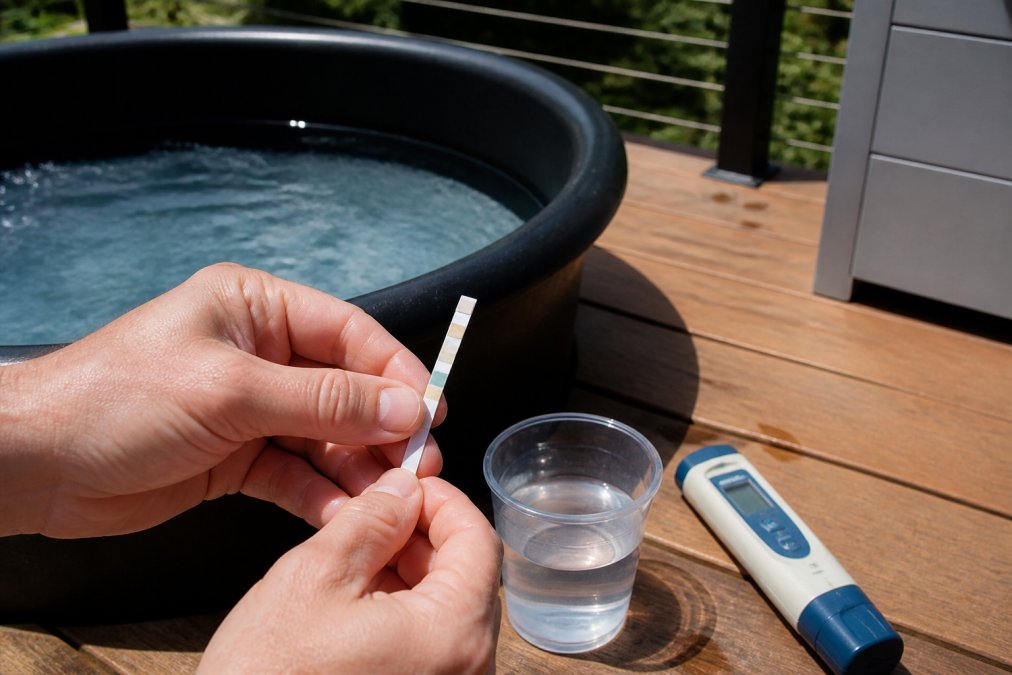
Testing strips are fine for routine checks, but a digital pH meter gives more precise readings if you are chasing a stubborn imbalance. Test before each session if the tub sees daily use, and at minimum every other day.
Preventing Algae, Biofilm, and Scale Buildup
Algae, biofilm, and scale are the three failure modes of cold plunge water, each with a different cause. Algae needs light and nutrients, so a covered tub in shade rarely develops it. Biofilm is more serious: a slime layer on wet surfaces that harbors pathogens and shields them from sanitizer.
Biofilm thrives in low-flow areas: inside plumbing, under the water line, and in filter housings. Once established, it resists normal sanitizer levels and requires either shock treatment plus physical scrubbing or a full drain and disinfection. A common mistake is sanitizing the water while ignoring tub surfaces, leaving the biofilm reservoir untouched.
Scale comes from hard water minerals, primarily calcium, depositing on heating elements, chiller components, and tub walls. It reduces heat transfer efficiency, forcing your chiller to work harder and shortening its lifespan. In a hard water area, periodic descaling is not optional.
Preventative maintenance beats remediation every time:
- Run circulation long enough to turn over the full volume daily
- Scrub the waterline and tub walls weekly with a dedicated sponge
- Replace cartridge filters on the manufacturer's schedule
- Keep the tub covered when not in use to block debris and light
- Never leave standing water in the pump or plumbing between cycles
Hard Water vs. Soft Water and Seasonal Cold Plunge Care
Hard water and soft water demand opposite maintenance strategies, and most cold plunge guides ignore the distinction. Hard water is high in dissolved calcium and magnesium, driving scale buildup and pushing pH upward. Soft water has low mineral content, making pH easier to hold but the water feel slippery and slightly more corrosive to metal components.
Managing hard water. Scale deposits on chiller evaporators, heating elements, and pump impellers, reducing heat transfer efficiency and forcing the chiller to run longer for the same temperature drop, which shortens compressor life. If your source water tests above roughly 200 ppm calcium hardness (common across much of the Southwest and Midwest), a few practices help:
- Test calcium hardness monthly alongside pH and alkalinity.
- Use a scale inhibitor formulated for spas, not pool-scale products, which are dosed for much larger volumes.
- Wipe down the waterline and tub walls weekly; scale starts as a thin film before it hardens.
- Consider a pre-filter or inline hose filter when filling, which removes some calcium before it ever enters the tub.
- Descale the chiller loop on the manufacturer's recommended interval, typically every few months in hard water areas.
Managing soft water. Soft water is easier on equipment but can be aggressive toward metal fittings and can make sanitizer feel ineffective because the water lacks the mineral buffer that stabilizes pH. Watch for pH drifting downward, and check stainless fittings and heater elements for early pitting. If your home has a whole-house softener, fill from an unsoftened outdoor spigot, some hardness is protective for metal surfaces.
Environmental disposal of treated water. Can you drain chemically treated cold plunge water onto your lawn or garden? It depends on what is in it.
- Chlorine or bromine at normal residual levels (1-5 ppm) generally dissipates within a day or two in open air and sunlight, and many municipalities allow small volumes to be drained to landscaping. Let the tub sit uncovered for 24-48 hours with the sanitizer off before draining if you want to be conservative.
- Hydrogen peroxide breaks down into water and oxygen, so it is the least problematic to dispose of, but high concentrations can still shock plants.
- Biguanide, copper-based algaecides, and high cyanuric acid are the ones to be careful with. Copper is toxic to aquatic life and can accumulate in soil. High cyanuric acid does not break down quickly. For these, drain to a sanitary sewer (a utility sink or cleanout) rather than a storm drain or garden.
- Never drain to a storm drain, storm drains typically flow untreated to creeks, rivers, or lakes, and many jurisdictions prohibit discharging pool or spa water there.
When in doubt, check with your local water utility or municipal environmental office before draining. Requirements vary by jurisdiction, and a quick call avoids a fine.
Seasonal variation. Maintenance needs change drastically between summer and winter, and treating them identically causes most seasonal failures.
In summer, warmer temperatures accelerate microbial growth and raise sanitizer demand, so testing should rise from every other day to daily. Algae risk climbs, especially if the tub is uncovered or in direct sun. Keep the cover on when not in use, and expect to shock more often.
In winter, colder water slows microbial activity but adds two risks: freeze damage to plumbing and chiller components, and reduced circulation if the pump is not rated for cold operation. If your plunge sits in an unheated space, a garage, a covered patio in a cold climate, drain and winterize it rather than letting residual water freeze. A single freeze can crack a chiller line or pump housing. If you use the tub through winter, confirm the chiller and pump are rated for sub-freezing ambient temperatures, and keep the water moving.
For a system built to handle year-round use with integrated filtration and ozone, the RevX X Tub Acrylic Cold Plunge with LUX High-Performance Chiller & Filtration System combines a deep acrylic tub with a chiller and filtration package designed to keep water chemistry stable across seasons.
Conclusion: Building a Simple Weekly Hygiene Routine
Knowing how to maintain water hygiene in cold plunges comes down to consistency, not complexity. A short weekly routine, backed by daily circulation and honest testing, keeps water clear and safe. The owners who struggle are almost always the ones who skip testing until something looks wrong, at which point the fix is a full drain rather than a quick adjustment.
If you would rather spend your time in the water than managing it, Vital Fit Home carries cold plunge systems with filtration, UV, and ozone sanitation built in, plus free shipping across the continental United States and wellness design guidance to help you match a setup to your space. Get started with Vital Fit Home and build a plunge you can step into without a second thought.
Frequently Asked Questions
How often should you change the water in a cold plunge?
Most home cold plunge owners change water every 4 to 8 weeks, depending on use and filtration. With a quality cold plunge water filtration system and proper sanitizer, you can stretch it to 8 weeks. Heavy daily use, visible cloudiness, or a strong odor means change sooner. Always drain, clean the tub, and refill with fresh water before restarting your routine.
Do you need to use chemicals in a cold plunge?
Not always, but some sanitizer is recommended for shared tubs. Hydrogen peroxide is a popular non-chlorine option that breaks down into water and oxygen. Chlorine and bromine work well but require careful dosing. Ozone systems and UV filtration reduce chemical demand. If you have sensitive skin, start with hydrogen peroxide and test pH and alkalinity weekly to keep water balanced.
What is the best filtration system for a home cold plunge?
A combination of cartridge filtration, UV sterilization, and ozone is the most effective setup. Cartridge filters trap sediment and debris, UV light neutralizes pathogens, and ozone oxidizes contaminants. The RevX X-FLOW Cold Plunge Filtration System uses UV plus a 20-micron pump to keep water clear and circulating. Pair it with a regular testing schedule for best results.
How can I prevent algae growth in my ice bath?
Algae needs light and stagnant water. Keep your cold plunge covered when not in use, run the circulation pump daily, and maintain sanitizer levels. Clean cartridge filters every two weeks and shock the water monthly with hydrogen peroxide or chlorine. If algae appears, drain the tub, scrub the walls with a mild cleaner, rinse thoroughly, and refill with fresh water before restarting filtration.


Leave a comment
This site is protected by hCaptcha and the hCaptcha Privacy Policy and Terms of Service apply.