
Design a Small Home Wellness Sanctuary: Step-by-Step
Table of Contents
- Define Your Wellness Goals and Space Purpose
- Small Home Wellness Room Ideas: Layout and Dimensions
- Wellness Room Lighting Ideas for Relaxation and Recovery
- Small Meditation Room Ideas: Creating Sensory Comfort
- Home Recovery Room Setup: Choosing Your Wellness Technologies
- Ventilation, Humidity, Electrical, and Safety Planning
- Budget-Friendly and Renter-Friendly Wellness Space Solutions
- Putting It Together: Your Wellness Sanctuary Implementation Plan
- Frequently Asked Questions
Last Updated: October 15, 2026
Define Your Wellness Goals and Space Purpose
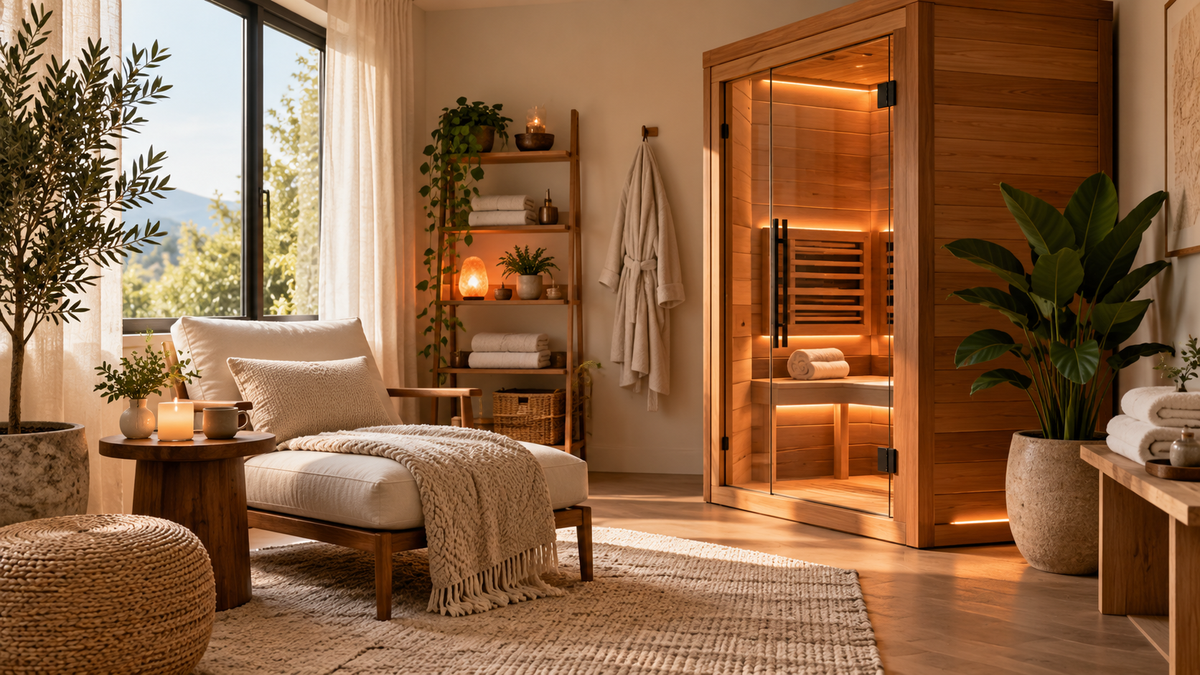
A small home wellness sanctuary is a dedicated personal retreat designed to support recovery, relaxation, and well-being within a limited footprint.
List your top three wellness priorities. Space constraints force trade-offs: an 8-by-10 room cannot hold both a sauna and a cold plunge, and a bedroom corner cannot support an infrared sauna, meditation platform, and full-body red light system at once.

At Vital Fit Home, we help customers work backward from their goals rather than forward from equipment catalogs.
Small Home Wellness Room Ideas: Layout and Dimensions
Measuring Your Space
Grab a tape measure and get exact dimensions. Ceiling height is critical: an infrared sauna typically requires at least 6 feet 4 inches of clear space, and a wall-mounted red light therapy panel needs about 3 feet of standing distance in front of it.

Measure corner to corner, note outlet locations, and mark windows, doors, and obstacles like HVAC vents or fixtures. Take photos from multiple angles as your baseline for every layout decision.
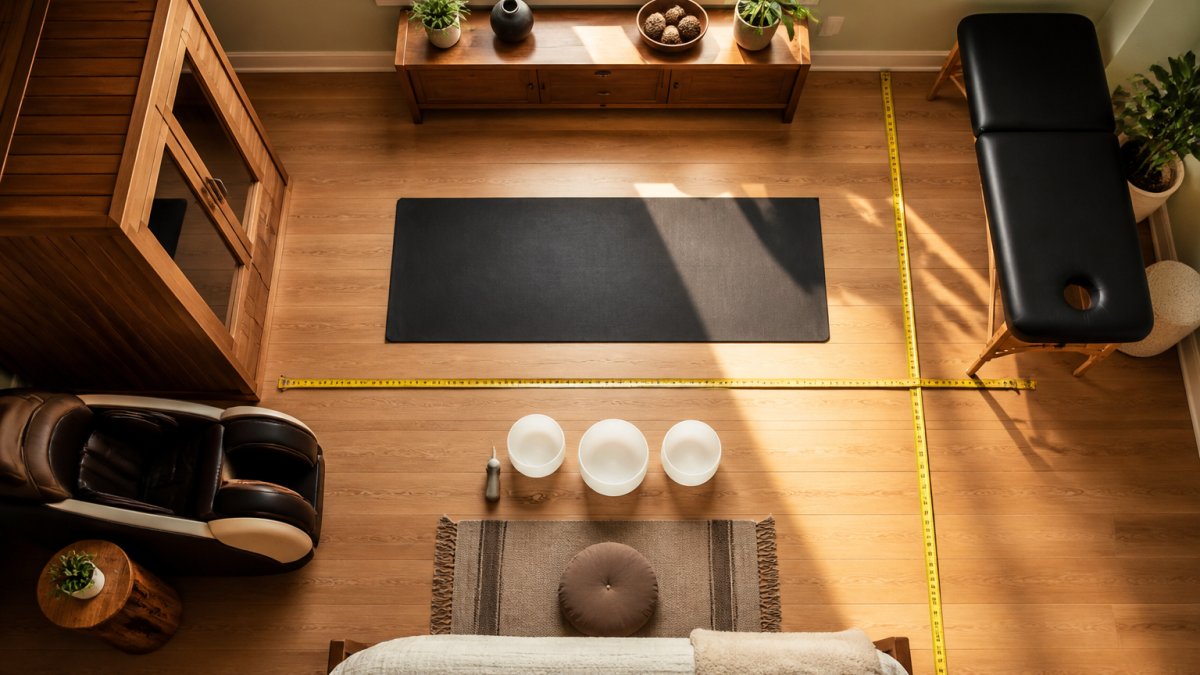
Write down these specific measurements:
- Total square footage
- Ceiling height (measure in multiple spots, older homes aren't always level)
- Distance from wall outlets
- Window size and direction (north, south, east, west)
- Door swing clearance
- Any structural elements (beams, pipes, radiators)
Single-Zone vs. Multi-Functional Layouts
A single-zone layout dedicates the entire room to one primary function.
Multi-functional layouts serve multiple purposes in one footprint: one corner for meditation, another for red light therapy, with portable equipment like the ECHO Flask Hydrogen Water Bottle on a shelf.

The key constraint is sensory conflict. A meditation space requires quiet and minimal visual stimulation. A recovery space with active therapies (red light, sauna) generates heat, humidity, and sometimes sound.
For most small spaces, we recommend a primary-use layout with one or two secondary elements. A primary meditation room with a small red light therapy panel works.
Wellness Room Lighting Ideas for Relaxation and Recovery
Natural Light and Circadian Support
Natural light shapes your nervous system. Morning light signals wakefulness. Evening dimness signals rest. A wellness room that ignores circadian rhythm undermines its own purpose.
If your space has windows, position your primary activity to use natural light during your intended use time.
If your space has no windows, you'll rely entirely on artificial lighting, which requires intentional design from scratch.
Dimmable and Color-Tuned Lighting
The best lighting for a small wellness room is dimmable and color-adjustable. Bright white light (5,000K or higher) energizes. Warm amber light (2,700K or lower) signals rest.
Install dimmers on all overhead lights and add warm-toned accent lighting (wall sconces, floor lamps) you can control independently.
For active recovery (red light therapy, stretching), brighter light works. For meditation or wind-down, dim the room to 30-40% brightness and shift to warmer tones.
Small Meditation Room Ideas: Creating Sensory Comfort
Sound Control and Quiet Zones
Sound travels easily in small rooms. External noise breaks concentration, and equipment noise (sauna fans, ventilation) creates stress rather than relief.
Seal gaps under doors with weatherstripping, use heavy curtains or acoustic panels, and add a white noise machine or soft background sound to mask external noise without expensive soundproofing.
If you're adding equipment like a sauna or ventilation system, position it away from your meditation area.
Calming Colors, Textures, and Biophilic Elements
Color psychology matters in a small space because you're surrounded by it.
Choose one primary wall color and keep others neutral.
Texture adds sensory richness without visual clutter: natural wood, soft rugs, linen cushions, and stone surfaces create tactile comfort.
Keep surfaces clean and clutter-free. A small wellness room should feel intentional, not crowded. Storage for equipment and supplies should be out of sight.
Home Recovery Room Setup: Choosing Your Wellness Technologies
Red Light Therapy and Infrared Sauna Options
Red light therapy uses specific wavelengths (typically 600-1000 nanometers) to support cellular function and recovery.
Both fit small spaces. The Small Panel red light therapy device ($749) is portable and mounts on a wall or stands on a shelf.
The Durasage 2-Person Carbon Infrared Sauna ($3,295) measures 47.6 inches wide by 41.7 inches long.
Both technologies require consistency: red light therapy typically calls for 3-5 sessions per week, and infrared sauna works best 3-4 times weekly.
Cold Plunge, Sauna, and Contrast Therapy Considerations
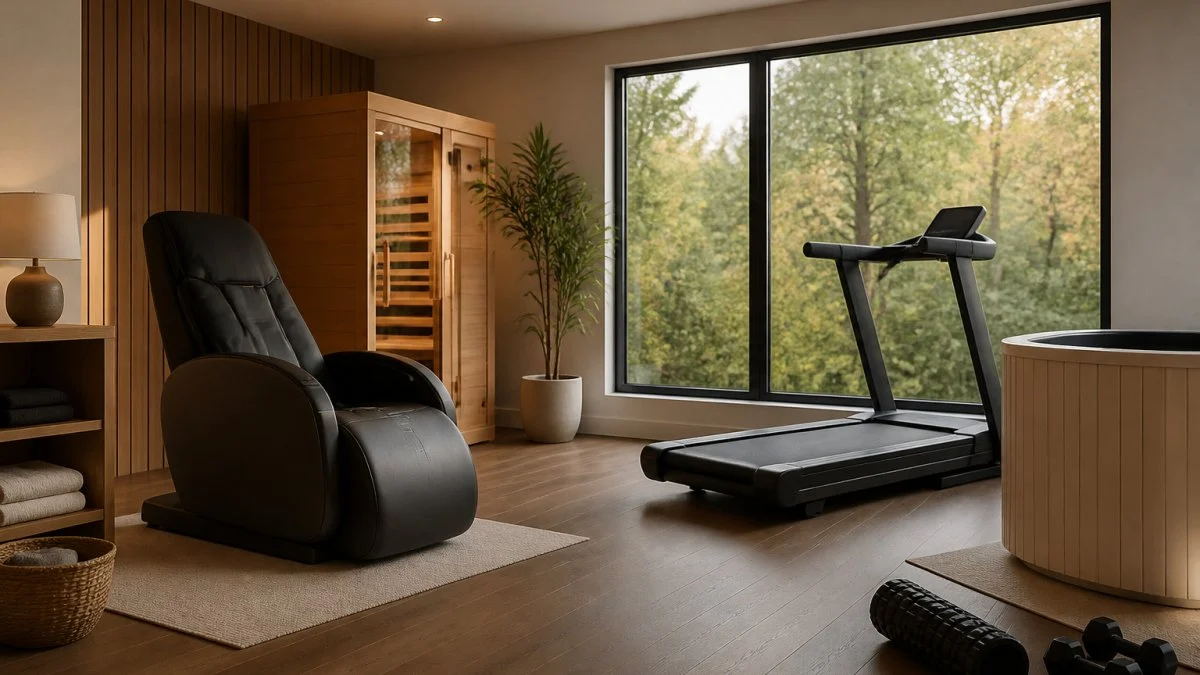
Contrast therapy alternates heat and cold to stimulate circulation and recovery, requiring two separate systems: a sauna and a cold plunge, which is space-intensive.
A small room cannot hold both a full-size sauna and a dedicated cold plunge tub.
If contrast therapy is your priority, consider:
- A portable cold plunge tub that you drain and store between uses
- A sauna session followed by a cold shower (lower tech, lower cost)
- Alternating days: sauna one day, cold exposure the next
Contrast therapy works, but it's not essential for most wellness goals. Single-modality recovery (sauna alone or cold exposure alone) delivers real benefits without requiring two large installations.
Hydration and Molecular Hydrogen Integration
Hydration is foundational to recovery. The ECHO Flask Hydrogen Water Bottle ($299.99) generates molecular hydrogen in your water, which research suggests supports antioxidant activity and cellular recovery.
Durasage 2-Person Carbon Infrared Sauna - Canadian Hemlock Wooden Sauna - 1700 →
It requires no installation, sits on a shelf, and integrates into any wellness room. Use it before or after your primary recovery activity to support hydration.
Molecular hydrogen is one of the lower-cost wellness additions and works alongside any other technology you choose.
Ventilation, Humidity, Electrical, and Safety Planning
Ventilation and Moisture Control
Heat and humidity require ventilation.
Minimum: a bathroom exhaust fan or window that opens during and after use. Better: dedicated ducting that exhausts humid air outside.
Check local building codes before installing any ventilation system. Some jurisdictions require professional installation or permits. Starting with code compliance prevents problems later.
Monitor humidity with a simple meter (available for under $20). Keep it below 60% in your wellness room. If humidity consistently exceeds that, your ventilation is inadequate.
Electrical Requirements and Professional Installation
Infrared saunas and some red light therapy systems draw significant power. The Durasage sauna requires a dedicated 120V outlet; larger systems might need 240V and an electrician.
Do not attempt electrical work yourself if you're unsure. Hire a licensed electrician to:
- Assess your home's electrical capacity
- Install dedicated circuits if needed
- Ensure proper grounding and safety switches
- Verify everything meets local code
This costs $300-800 typically but prevents fire risk, equipment damage, and safety hazards. It's non-negotiable.
Budget-Friendly and Renter-Friendly Wellness Space Solutions
Low-Cost Upgrades and Portable Equipment
You don't need to spend $10,000 to create an effective wellness room. Start with fundamentals and add technology incrementally.
Foundational upgrades (under $500 total):
- Dimmable bulbs and warm-toned lighting ($80-150)
- Weatherstripping and acoustic treatment ($50-100)
- Plants and natural decor ($100-150)
- Meditation cushion and yoga mat ($80-150)
Mid-tier additions (add one at a time):
- Red light therapy panel like The Small Panel ($749)
- Hydrogen water bottle ($299.99)
- Quality air purifier ($200-400)
Premium additions (when budget allows):
- Infrared sauna ($3,000+)
- Hyperbaric chamber or advanced recovery equipment
For renters, focus on portable solutions. Red light panels, hydrogen bottles, meditation cushions, and plants all move with you. Avoid permanent installations like built-in saunas or electrical upgrades unless you own the space.
Accessibility and Inclusive Design for All Ages
A wellness room should work for your household. If you have aging parents visiting, mobility challenges, or family members with different needs, design accordingly.
Consider:
- Wide doorways (36+ inches) for wheelchair access
- Non-slip flooring, especially near saunas or water features
- Grab bars or stable handrails if balance is a concern
- Adjustable-height equipment or seating options
- Clear pathways with minimal obstacles
Red light panels mount at various heights, meditation cushions come in different firmness levels, and hydrogen water bottles are lightweight. These details make the space functional for everyone, not just the primary user.
Putting It Together: Your Wellness Sanctuary Implementation Plan
Start with these steps:
-
Define your top three wellness goals. Recovery, relaxation, longevity, stress relief, performance, pick your priorities.
-
Measure your space precisely. Width, length, ceiling height, outlet locations, windows, obstacles. Write it all down.
-
Choose your primary activity. Meditation, sauna, red light therapy, or cold exposure. Design the room around that first.
-
Handle the basics. Lighting, color, sound control, ventilation. These cost $300-600 and transform the space immediately.
-
Add one primary technology. A red light panel or infrared sauna, not both initially. Let that become the room's centerpiece.
-
Integrate complementary systems. Hydrogen water bottle, meditation cushion, plants, these support your primary technology without competing for space.
-
Test for 30 days. Use the room consistently and notice what works. Adjust before adding more equipment.
-
Hire professionals for electrical and ventilation. Don't DIY these. Code compliance and safety matter.
The most effective wellness rooms are simple, intentional, and actually used. A small space with one well-chosen technology you use daily beats a large room packed with equipment you ignore.
Creating a small home wellness sanctuary is about matching your space to your actual needs, not fitting every trend into a corner. The right lighting, the right primary technology, and consistent use deliver real results.
Frequently Asked Questions
How do I design a small home wellness sanctuary when I only have a spare bedroom or bathroom?
Start by measuring your space and identifying which wellness activities matter most to you. A 100-square-foot room can comfortably fit meditation and breathing exercises, red light therapy, and hydration stations. A 2-person infrared sauna like the Durasage (47.6" W x 41.7" L x 74.4" H) requires roughly 50 square feet of dedicated floor space. Prioritize one or two core recovery technologies, such as red light therapy and hydrogen-enhanced hydration, rather than trying to fit everything into a small space. Use vertical storage, wall-mounted lighting, and multipurpose furniture to maximize usable area.
What's the most cost-effective way to start a home wellness sanctuary on a budget?
Begin with foundational elements: calming lighting ($50-$200), plants and biophilic design (minimal cost), sound dampening (acoustic panels, $100-$300), and a portable red light therapy device like The Small Panel ($749). Add hydrogen-enhanced hydration with the ECHO Flask ($299.99) to support recovery and cellular health. These entry-level tools create meaningful wellness benefits without major renovations. As your budget grows, invest in larger equipment like an infrared sauna. Renter-friendly options include portable devices and removable wall treatments that don't require permanent installation.
Do I need professional installation for an infrared sauna or other wellness equipment in my home?
Most infrared saunas like the Durasage require a standard 120V electrical outlet and minimal assembly, many homeowners install them without contractors. However, if your space lacks adequate ventilation, electrical capacity, or you're adding multiple high-power devices (sauna, cold plunge, red light therapy), consult a licensed electrician to ensure your home's electrical panel can handle the load safely. Proper ventilation is critical to prevent humidity buildup; assess whether your room has existing ventilation or needs upgrades. Vital Fit Home provides installation guidance and support to help you understand what's needed before purchase.
What wellness technologies actually deliver measurable results in a small home space?
Red light therapy supports cellular recovery and has strong research backing for muscle recovery and circulation. Infrared saunas promote relaxation, cardiovascular function, and detoxification. Hydrogen-enhanced hydration (via the ECHO Flask) targets cellular health and antioxidant support. Cold plunges and contrast therapy improve circulation and resilience, though they require careful temperature management. Meditation, breathing exercises, and mindfulness are foundational and cost nothing. The most effective approach combines two or three complementary technologies with consistent daily use rather than investing in everything at once. Your specific goals, recovery, stress management, longevity, determine which technologies will serve you best.


Leave a comment
This site is protected by hCaptcha and the hCaptcha Privacy Policy and Terms of Service apply.