

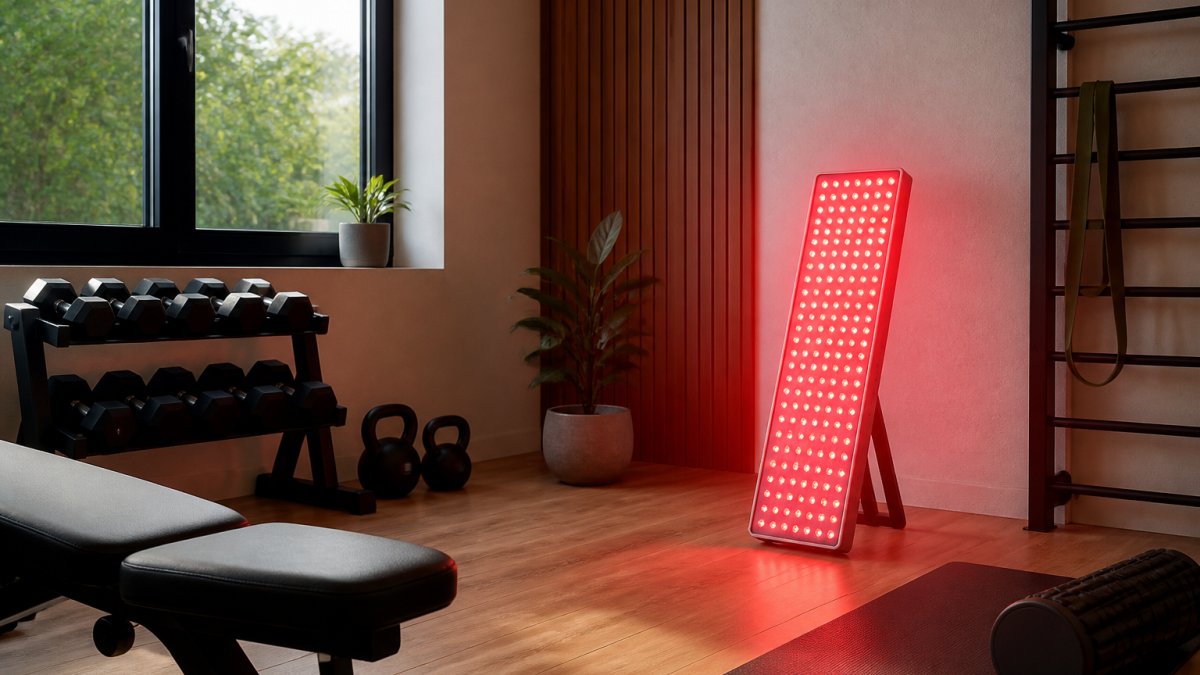
Benefits of Red Light Therapy in Your Home Gym
Last Updated: October 22, 2026
Quick Summary
Adding red light therapy to your home gym gives you a convenient, consistent, low-effort recovery habit that supports muscle repair between sessions. Sessions take just minutes right after you train, and using it more often is easier when the device sits in the room you already work out in.
- Red wavelengths act near the skin's surface, while near-infrared wavelengths travel deeper into muscle and joint tissue.
- For most home gym users, using red light therapy after training beats using it before.
- Start with short sessions of around five to ten minutes per area and build up over two weeks.
- More time under the light is not better and can leave skin red or irritated.
- The EXESAS 1216 panel runs four wavelengths with 1,216 dual-chip LEDs in a full-body frame.
Table of Contents
- Why Red Light Therapy Belongs in a Home Gym
- How Red Light Therapy for Muscle Recovery Works
- Red Light Therapy Before or After Workout: Which Timing Wins
- Red Light Therapy Session Length and Frequency
- Choosing a Red Light Therapy Panel for Home Gym Use
- Setting Up Your Recovery Corner Without Wrecking the Room
- Conclusion
- Frequently Asked Questions
Why Red Light Therapy Belongs in a Home Gym
Red light therapy is a non-invasive treatment that uses specific wavelengths of red and near-infrared light to support recovery, skin health, and cellular energy (What to Look for in Red Light Therapy: A Product Guide Backed by Science). At Vital Fit Home, we see it as the missing piece in most home gym setups: a recovery tool that works while you stand still.

Here is the core idea. You already invest in training. But muscle repair happens between sessions, not during them. A red light panel gives you a daily, low-effort way to support that repair at home, without booking an appointment or leaving the house.
The benefits of adding red light therapy to your home gym come down to three things:
- Convenience: sessions take minutes, right after you rack the weights
- Consistency: you use it more when it sits in the room you already train in
- Low effort: no setup, no cold water, no scheduling
What most guides miss is that light therapy is not a workout. It is a recovery habit. Treat it like stretching, not like cardio.
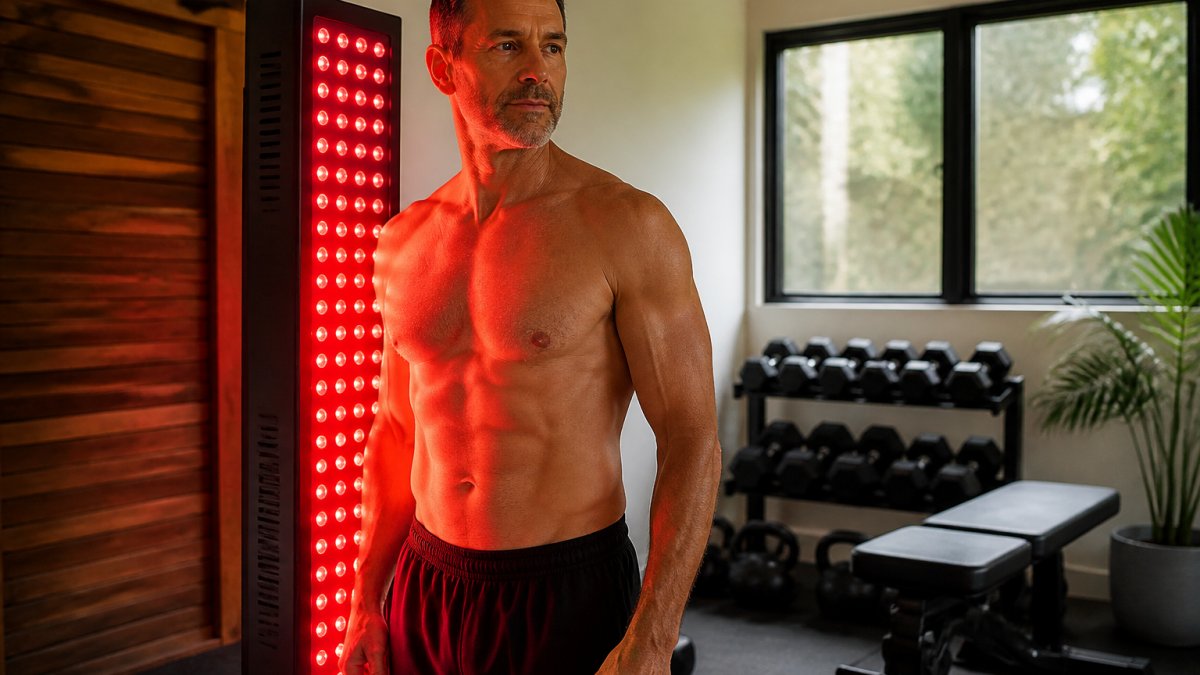
How Red Light Therapy for Muscle Recovery Works
Red light therapy for muscle recovery works by delivering red and near-infrared light into the skin and deeper tissue, where cells respond by supporting their own energy production. Light in the red and near-infrared range is the part of the spectrum most studied for tissue response.
You do not need a biology lesson to use it well. You need to know three things: what the light reaches, what results look like early on, and how to judge progress honestly.
What the Light Actually Reaches
Red wavelengths mostly act near the skin's surface. Near-infrared wavelengths travel deeper, into muscle and joint tissue.
That difference matters for recovery. A panel that offers both wavelengths gives you surface support and deeper tissue exposure in one session. This is why most full-body panels list both red and near-infrared output as core specs.
What to Expect in the First Few Weeks
Expect subtle changes first, not dramatic ones. Many users report feeling looser or less stiff after sessions, especially in the days after hard training.
The honest version: light therapy is cumulative. Skipping days slows progress. Most people who quit early did so because they expected a single session to feel like a massage. It does not.
Red Light Therapy Before or After Workout: Which Timing Wins
Red light therapy before or after workout is a real question, and the answer depends on your goal. For most home gym users, after training wins.
Here is why. After a session, your muscles are primed for repair. Light exposure then supports that window. Before training, the case is weaker for most people, though some use it as part of a warm-up routine.
A simple way to decide:
| Goal | Best Timing | Why |
|---|---|---|
| Muscle recovery | After workout | Supports the post-training repair window |
| General daily routine | Morning or evening | Easy to keep consistent |
| Warm-up feel | Before workout | Loosens up stiff joints |
| Skin-focused use | Any time | Consistency matters more than timing |
The bigger factor is not timing. It is whether you actually do it. Pick the slot you will keep.
Red Light Therapy Session Length and Frequency
Red light therapy session length is usually shorter than people expect. Most home sessions run somewhere between a few minutes and roughly twenty minutes per area, depending on the device and the distance from the panel.
Frequency matters more than duration. A common approach is daily or near-daily use at a moderate session length. Longer sessions are not automatically better, and overdoing it can leave skin feeling warm or irritated.
The Large Panel – Full Body Red & Near-Infrared Light Therapy Panel →
A practical routine:
- Start short, around five to ten minutes per area
- Build up gradually over the first two weeks
- Keep the panel at the distance the manufacturer recommends
- Use eye protection if the device includes it
- Stay consistent rather than pushing longer sessions
Choosing a Red Light Therapy Panel for Home Gym Use
A red light therapy panel for home gym use should match your space, your coverage needs, and your routine. Power and wavelength range matter, but so does whether the device fits where you will actually use it.
Look at four specs first:
- Wavelengths: red and near-infrared, both listed clearly
- Coverage: full-body panels cover more area per session
- Output: higher irradiance means shorter sessions
- Controls: timers and separate red/infrared modes help
At Vital Fit Home, we carry panels built for exactly this use. The EXESAS 1216 LED Full Body Red Light Therapy Panel runs four wavelengths (630nm, 660nm, 810nm, and 850nm) with 1,216 dual-chip LEDs and a full-body frame at 75" x 22". It includes a stand, remote, timer, and protective eyewear.
For a simpler, lower-cost entry point, The Large Panel offers preset modes and wide coverage at $2,250.00. Both are designed to stand in a home gym without dominating the room.

Panel, Mat, or Blanket: Matching the Device to Your Space
Panels suit standing sessions and full-body exposure. Mats and blankets suit lying down and travel.
| Device Type | Best For | Trade-off |
|---|---|---|
| Panel | Standing sessions, full-body coverage | Needs floor space and a stand |
| Mat | Lying down, easy storage | Less coverage per session |
| Blanket | Portability, wrap-style use | Higher cost for full-body models |
The Nushape LipoMat uses 1,600 LEDs at 635nm and 850nm in a foldable mat, priced at $1,399.00. The EnergyLounger Blanket wraps the body at 660nm and 850nm and comes with a travel case at $6,500.00.

Setting Up Your Recovery Corner Without Wrecking the Room
A recovery corner works best when it is easy to reach and easy to ignore. The goal is a spot you walk past every day, so using it becomes automatic.
Start with placement. Put the device near your training area, not in a spare room you rarely enter. You need clear floor space in front of a panel, or a flat surface for a mat.
Then handle the practical details:
- Check the outlet and circuit load before you commit to a spot
- Keep the device away from damp areas and direct water
- Leave room to store eye protection and a timer nearby
- Plan lighting so the room stays usable for normal training
If you are building a full wellness room, our wellness design service helps map out where each piece goes before you buy. We also offer free shipping across the continental US.
Conclusion
The hardest part of any recovery habit is not the equipment. It is showing up on the days you feel fine and would rather skip it. A red light panel sitting in your gym removes most of that friction.
At Vital Fit Home, we help you choose the right device for your space, from full-body panels to foldable mats, with expert guidance and support after the sale. Our team can walk you through wavelengths, coverage, and room planning so the setup fits your goals.
Get started with Vital Fit Home and build a recovery corner you will actually use.
Frequently Asked Questions
What are the benefits of red light therapy after a workout?
Using red light therapy after training is the most common approach because it targets tissue that has just been stressed. Users typically report less next-day soreness and a feeling of looser, less stiff muscles. The light is thought to support the body's own repair processes in the tissue it reaches. It is not a substitute for sleep, protein, or hydration, but it stacks well with them. A short session of roughly 10 to 20 minutes on the trained area is the usual starting point.
How long should a red light therapy session last?
Most home users land between 10 and 20 minutes per session, per area. The right number depends on the device's irradiance, which is the intensity of light it delivers. A high-output panel like the EXESAS 1216, rated above 220 mW/cm², delivers a meaningful dose faster than a lower-output mat. Start at the low end of the range, watch how your body responds over a week, and extend only if you feel no difference. More time is not automatically better.
Should you use red light therapy before or after exercise?
Both have a case. Before a workout, a short session may help muscles feel warm and ready to move. After a workout, it aligns with recovery, which is why most home gym owners default to post-training use. If you only have time for one, put it after. If you train in the evening, keep the session earlier in the evening so the bright light does not interfere with winding down.
Is red light therapy safe to use at home?
Home red light therapy devices are generally well tolerated when used as directed. The main rule is eye protection: wear the eyewear that ships with panels like the EXESAS 1216 and avoid staring directly into the LEDs. Skip sessions on broken skin or areas your doctor has flagged. If you take medication that increases light sensitivity, check with your physician first. Follow the manufacturer's timer and distance guidance rather than improvising longer sessions.

Leave a comment
This site is protected by hCaptcha and the hCaptcha Privacy Policy and Terms of Service apply.